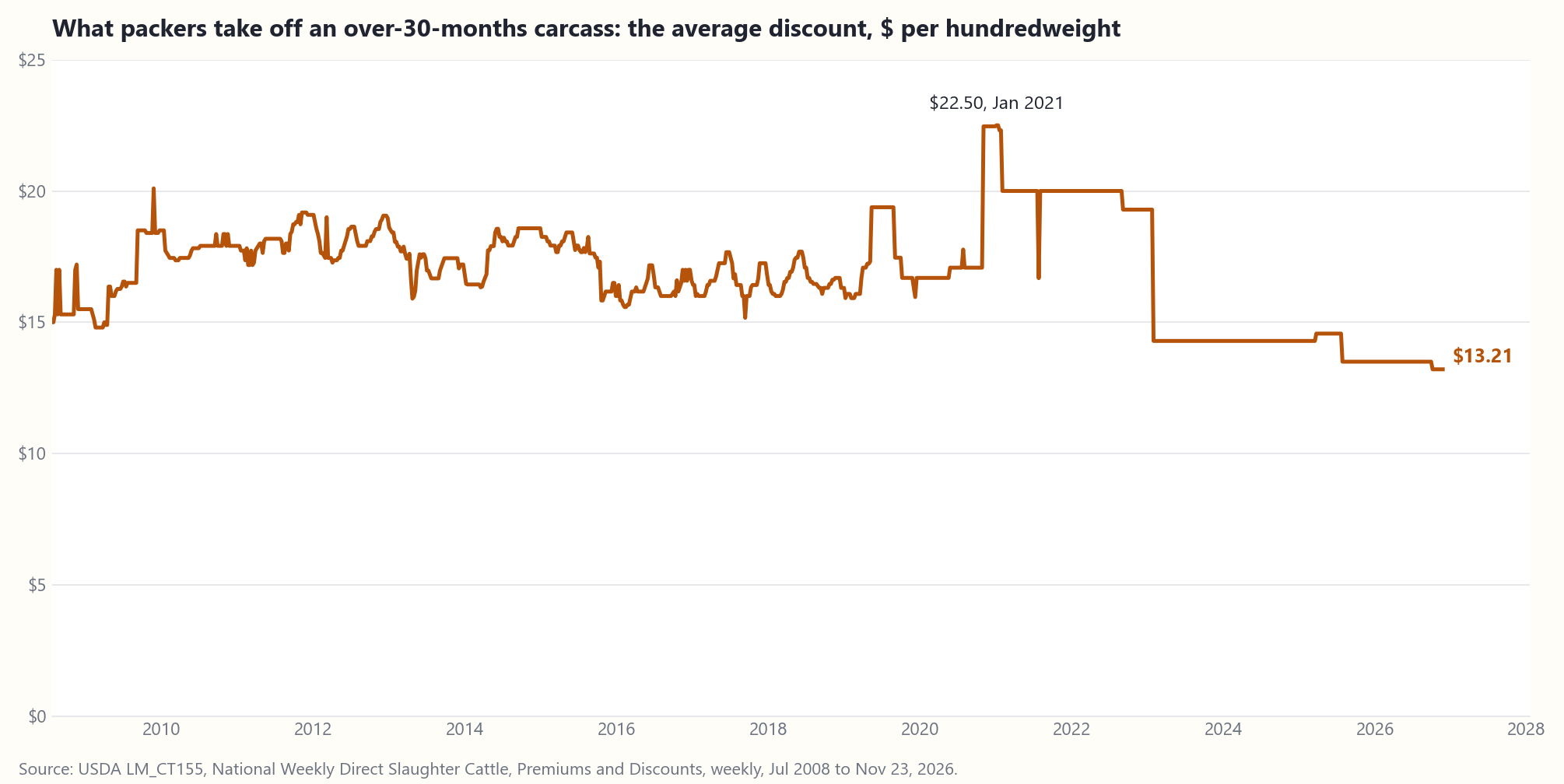
Over thirty months, or OTM, is the age line in the beef trade. Cattle 30 months and older lose more of the carcass at the plant, their beef cannot go to some export markets, and packers pay less for them. In the week of November 23, 2026, packers took an average of $13.21 a hundredweight off an OTM carcass. On a 993 pound steer carcass that is about $131 a head. It is the smallest OTM discount in USDA's record, which starts in July 2008.
What changes at 30 months
USDA's rule names parts of cattle 30 months and older as specified risk materials, or SRMs. They are inedible and cannot be used as food:
- the brain, skull, eyes and trigeminal ganglia - the spinal cord and the dorsal root ganglia - the vertebral column, except the tail, the side processes of the back and loin vertebrae, and the wings of the sacrum
Two parts are SRM at any age: the tonsils and the distal ileum, the end of the small intestine. For OTM cattle, the spinal cord has to be removed at the plant where the animal was slaughtered.
The rule dates from January 2004. USDA wrote it after the first US case of BSE, mad cow disease, was diagnosed in a Washington State dairy cow on December 23, 2003. The age line follows the disease: of the cattle that developed BSE in the field, USDA counted only 0.01 percent under 30 months of age.
How a plant knows the age
Two ways, by the 2004 rule. Records that come with the animal, such as a birth certificate, are accepted if inspectors find them reliable. Without them, inspectors check the teeth: an animal with at least one of its second set of permanent incisors through is treated as 30 months or older. Those teeth erupt between 24 and 30 months.
USDA's graders use the teeth too. Since 2017, a carcass from an animal under 30 months by its teeth is graded as the youngest maturity group. In Canada, marbling at the rib sets the grade, and the carcass has to look young to qualify for the top grades: the grader checks the cartilage on the backbone, not the animal's age. The Canada AAA vs USDA Choice article covers that.
Where OTM beef cannot go
South Korea still bars US beef from cattle more than 30 months of age, as of the US Meat Export Federation's October 2025 report. Korea took 24 percent of US beef exports in 2025, more than any other country, so beef for Korea has to come from cattle under 30 months.
Japan dropped its age limit on May 17, 2019. Since then US exporters can ship Japan beef from cattle of any age.
What it costs the feeder
Packers that buy cattle on a carcass grid take a discount off an OTM carcass. USDA prints the schedules weekly. The average discount:
| Period | Average OTM discount, $ per cwt |
|---|---|
| 2009 to 2020, yearly averages | about $16 to $18 |
| January 2021, the peak | $22.50 |
| 2021, yearly average | $20.12 |
| 2024, yearly average | $14.29 |
| 2026 to date | $13.45 |
| Since October 5, 2026 | $13.21, the smallest on record |
The average hides a wide spread between packers. In 2026 the schedules ran from no discount at all to $40 a hundredweight. From November 2020 to January 2023, the deepest schedule took $100.
Canada
Canada draws the same line. The Canadian Food Inspection Agency lists the skull, brain, trigeminal ganglia, eyes, tonsils, spinal cord and dorsal root ganglia of cattle 30 months and older as SRM, and the distal ileum of cattle of any age. It is a food safety rule, not a grading rule.
Canada's grades read the marbling at the rib, and to qualify for AAA a carcass must also look young by its bones; the animal's age is not checked. So an OTM carcass whose backbone cartilage still reads young can grade AAA. With fewer cattle to go around, some Canadian AAA now comes from OTM cattle, and the seller says so before the sale.