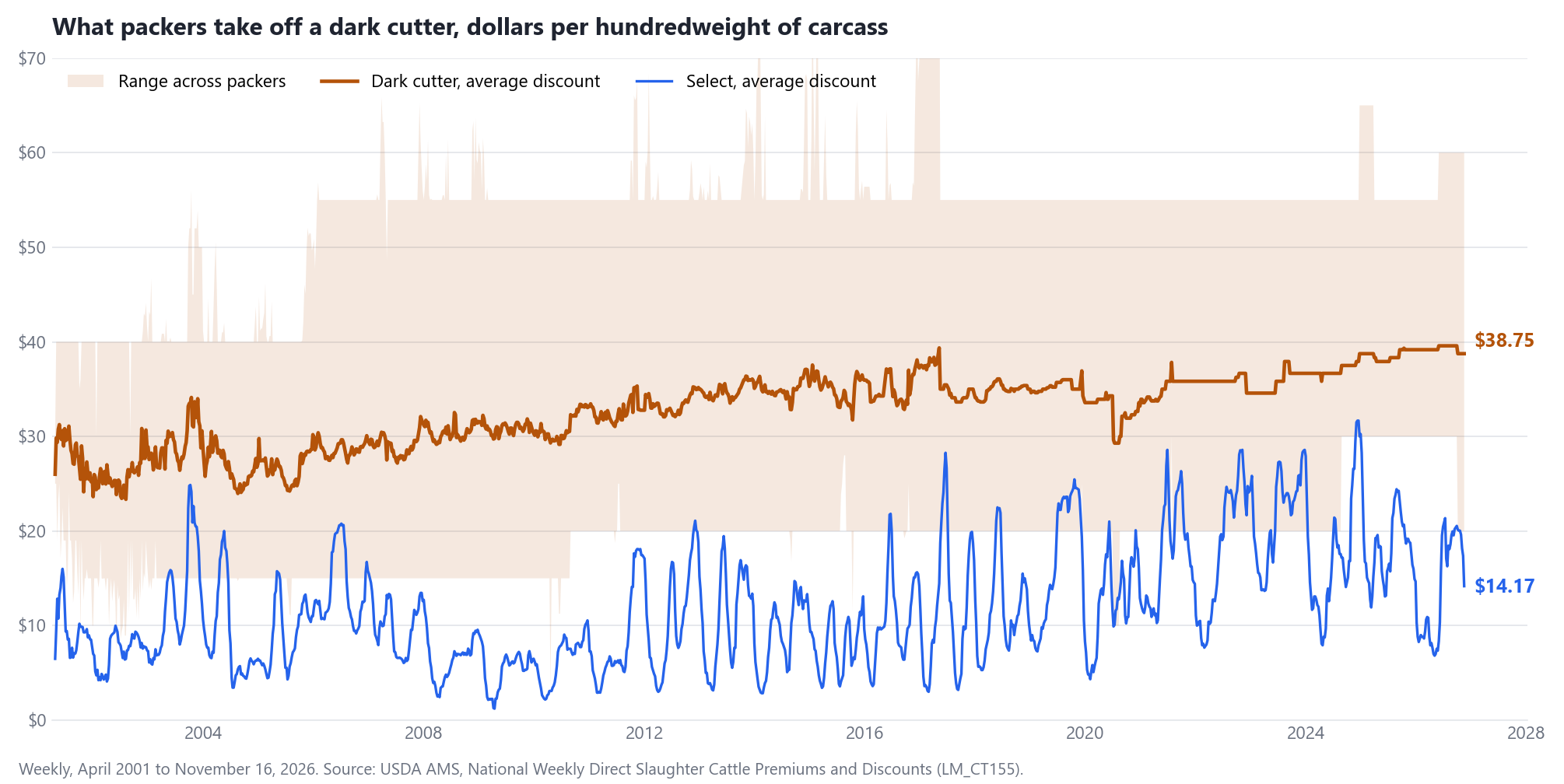
A dark cutter is a beef carcass whose lean stays dark when it is cut, instead of turning cherry red. Packers took an average of $38.75 a hundredweight off such a carcass in the week of November 16, 2026. On a 993 pound steer carcass that is about $385 a head. The discount has averaged more in 2026 than in any year of USDA's record, which starts in 2001.
What it is
USDA's grade standard describes it in one sentence: dark-cutting beef "is believed to be the result of a reduced sugar content of the lean at the time of slaughter." The colour runs from barely noticeable to what the standard calls "black cutters," where the lean is nearly black and feels gummy.
The sugar is the muscle's stored energy. An animal that is stressed, worked up or off feed before slaughter burns it. After slaughter, a normal muscle turns that sugar into acid, and the acid is what lets the lean brighten. With the sugar gone, the acid never forms. Canada's Beef Cattle Research Council puts the line at a pH above 5.8.
The animal can be young, well finished and well marbled. The fault is in the last day or two, not in the feeding.
How often it happens
The 2022 National Beef Quality Audit looked at 9,746 fed carcasses in 35 plants. It found dark cutting in 1.8 percent of them. The audit before it, in 2016, found 1.9 percent.
That is about one carcass in 55. In Canada the research council says it is more common in late summer and early fall.
What grading does with it
A dark cutter is still graded. The grader lowers the grade for it, by an amount that depends on how dark the lean is:
| Carcass would have graded | Dark cutting can lower it by |
|---|---|
| Prime, Choice or Select | Up to one full grade |
| Standard or Commercial | Up to half a grade |
| Utility, Cutter or Canner | Nothing: it is not considered |
In the 2022 audit, about a third of the dark cutters lost a third of a grade and about one in six lost the full grade.
The standard is frank about why. It says there is "little or no evidence" that the condition hurts eating quality, and that it counts in grading "because of its effect on acceptability and value." The Canadian research council reads it less kindly and calls the beef tougher than typical beef. The two sources do not agree on that point.
What the packer takes
The grade is one cost. The packer's own schedule is the bigger one. USDA collects what each packer adds or takes off for quality, and prints the range and the average every week:
| Week of Nov 16, 2026 | Range across packers | Average |
|---|---|---|
| Bullock or stag | $15 to $60 off | $42.50 off |
| Dark cutter | $20 to $60 off | $38.75 off |
| Hardbone | $20 to $55 off | $35.10 off |
| Standard | $10 to $60 off | $34.36 off |
| Select | $0 to $28 off | $14.17 off |
| Over 30 months | $0 to $40 off | $13.21 off |
Dollars per hundredweight of carcass. A dark cutter is docked almost three times what a Select carcass is.
On a 993 pound carcass the range works out to about $200 a head at the easiest packer and about $600 at the hardest. Dressed steers sold near $337 a hundredweight that week, so the average dock was about 11 percent of the animal.
It has mostly gone one way
| Year | Average dark cutter discount |
|---|---|
| 2001 | $28.02 |
| 2005 | $26.69 |
| 2010 | $31.02 |
| 2015 | $35.11 |
| 2020 | $32.67 |
| 2025 | $38.59 |
| 2026 (to Nov 16) | $39.27 |
The Select discount moves with the season, wide in some months and narrow in others. The dark cutter discount does not. It is a line on a packer's schedule, and it changes only when a packer rewrites the schedule. Over 25 years the rewrites have mostly gone up.
The year 2026 is the widest in the record. The average stood at $39.58 from June through September, the widest it has printed, and eased to $38.75 in October, where it has stayed.
In Canada it has its own grade
The United States lowers the grade. Canada gives the carcass a grade of its own: a youthful carcass that cuts dark is graded Canada B4. The Beef Cattle Research Council says the value of a B4 carcass is cut by up to 50 cents a pound, up to $300 a head, and that 1.4 percent of fed carcasses graded B4 in 2019.
Shelf life
The same thing that keeps the lean dark shortens its life. The research council's words: "the high pH stimulates the growth of spoilage bacteria, reducing shelf life." A buyer who holds vacuum-packed beef for weeks has a reason to care that is separate from colour.
Where the beef goes
No box says dark cutter. The words live on the feeder's settlement sheet, not on a price list.
In our trade, dark lean turns up far more in cow beef, the canner and cutter class, than in graded beef. The grade standard explains half of that: in those grades dark cutting is not considered at all, so nothing marks it.
It sells under the cut's own name. A ribeye is offered as a ribeye, and the buyer knows which plants put out that kind of product. It is not sold at a special discount box by box. The buyers are price buyers: commercial meat, lower-priced butcher shops and caterers, and some processors.