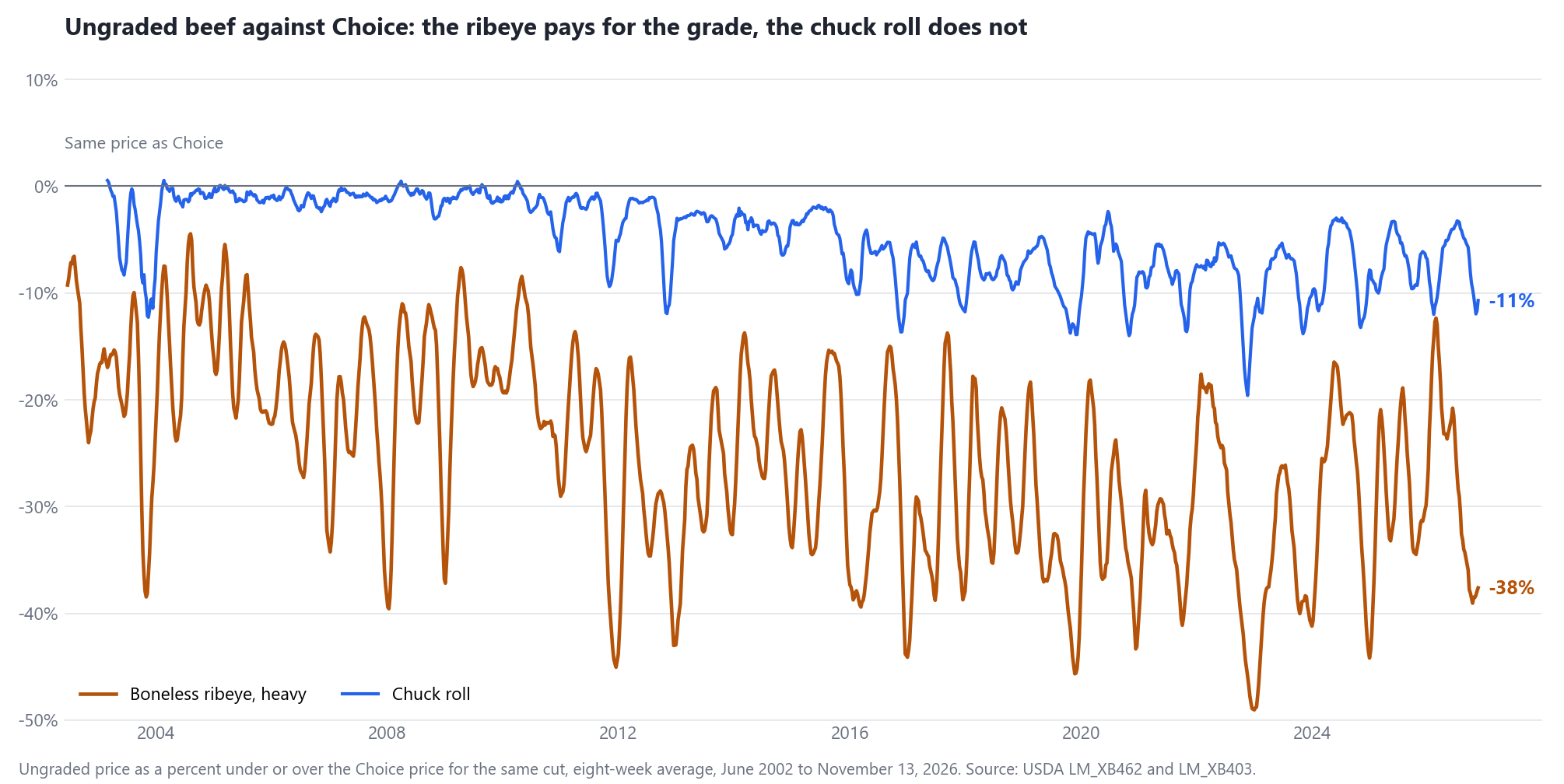
No-roll beef is beef that was never graded. The name comes from the grade stamp, which is rolled along the carcass: no grade, no roll. In the week ending November 13, 2026, an ungraded boneless ribeye sold for $9.97 a pound against $16.01 for Choice. An ungraded top inside round sold for $3.45 against $3.47. The grade is worth $6 a pound on one cut and two cents on the other.
What it is
Grading is voluntary. It is a USDA service the packer pays for, and it is separate from safety inspection, which every carcass gets. A carcass that is not presented for grading, or is not stamped, sells ungraded.
In the United States the trade says no roll. In Canada it says ungraded. They are the same idea, and a quote will use one word or the other.
USDA says where a lot of it comes from: "Standard and Commercial grades of beef are frequently sold as ungraded or as store brand meat." Those are the two grades under Select.
USDA prints a price for it
Most buyers know the Choice and Select reports. Fewer know there is a third. Every Monday USDA prints the week's negotiated sales of ungraded boxed beef, cut by cut, and it has done so since June 2002.
| Week ending Nov 13, 2026 | Ungraded | Select | Choice |
|---|---|---|---|
| Boneless ribeye, heavy | $9.97 | $13.91 | $16.01 |
| Strip loin, 0x1 | $7.45 | $7.94 | $8.49 |
| Top butt, boneless | $4.17 | $4.89 | $4.90 |
| Chuck roll | $5.08 | $5.36 | $5.33 |
| Brisket, deckle-off | $3.62 | $3.75 | $3.78 |
| Top inside round | $3.45 | $3.49 | $3.47 |
Dollars a pound. The ungraded column is USDA's weekly print. Choice and Select are the daily prints averaged over the same week.
The discount lives in the middle meats
Read down the table. The ungraded ribeye is 38 percent under Choice. The strip is 12 percent under and the top butt 15. The chuck roll is 5 percent under, the brisket 4, the inside round 1.
A buyer pays for a grade where marbling shows on the plate. On a ribeye that is most of the price. On a round it is almost none of it.
USDA's whole-carcass numbers say the same thing. For the same week:
| Per hundredweight | Ungraded | Select | Choice | Prime |
|---|---|---|---|---|
| Cutout | $323.92 | $349.98 | $355.73 | $393.98 |
| Rib primal | $505.04 | $625.33 | $643.08 | $739.21 |
| Loin primal | $371.46 | $409.70 | $434.16 | $559.71 |
| Chuck primal | $309.01 | $320.37 | $315.42 | $315.82 |
| Round primal | $277.66 | $279.33 | $280.65 | $280.73 |
The ungraded carcass is worth $26 a hundredweight less than Select. Of the primals, the rib carries $120 of gap and the round under $2.
The ribeye gap moves with the calendar
The ungraded ribeye has not once printed above Choice in the last ten years of weeks. But how far under depends on the month. Since 2016 it has run about 24 percent under Choice in January, February and July, and about 40 percent under in November and December.
The reason is in the Choice price, not the ungraded one. Graded ribeye is bid up for the holidays every fall. The ungraded ribeye is not the holiday roast, so it does not follow. The $6 gap in this article is a November gap. In midsummer the same comparison is closer to $3.
The chuck roll has a smaller season of its own: 5 to 7 percent under Choice most of the year, 11 to 13 in September and October.
It was not always this wide
In 2005 an ungraded ribeye ran about 3 percent under Select. In 2015 it ran about 21 percent under, and in 2026 about 19. The chuck roll moved too, from the same price as Choice before 2010 to a steady discount since.
What actually trades ungraded
Not ribeyes. Over the last 52 weeks the pounds USDA reported went mostly to end meats:
| Ungraded cut | Pounds reported, 52 weeks |
|---|---|
| Chuck roll | 18.8 million |
| Top inside round | 17.0 million |
| Strip loin, 0x1 | 8.8 million |
| Bottom gooseneck round | 8.5 million |
| Brisket, deckle-off | 6.5 million |
| Top butt, boneless | 6.2 million |
| Boneless ribeye, heavy | 5.0 million |
The reported trade is also much smaller than it was. USDA counted about 200 loads of ungraded cuts a week in the mid-2000s and counts about 53 now.
One number on USDA's wider report needs care. It shows 2,161 ungraded loads out of 6,075 in the week, more than a third. That line is labeled "cuts, trims, grinds." Trim and ground beef are never graded, so they are most of it.
What the box says
Usually nothing. The label names the cut, a top blade for instance, and no grade.
Crossing into Canada, it has to say so. The Canadian Food Inspection Agency requires an imported beef container to carry the grade name "or in the case of ungraded beef the words 'ungraded beef'."
Who buys it
In our trade the buyer is whoever can sell it without a customer complaining. That means anyone who has not promised a grade, in Canada anyone who has not promised A or AA, and who wants the lower price.