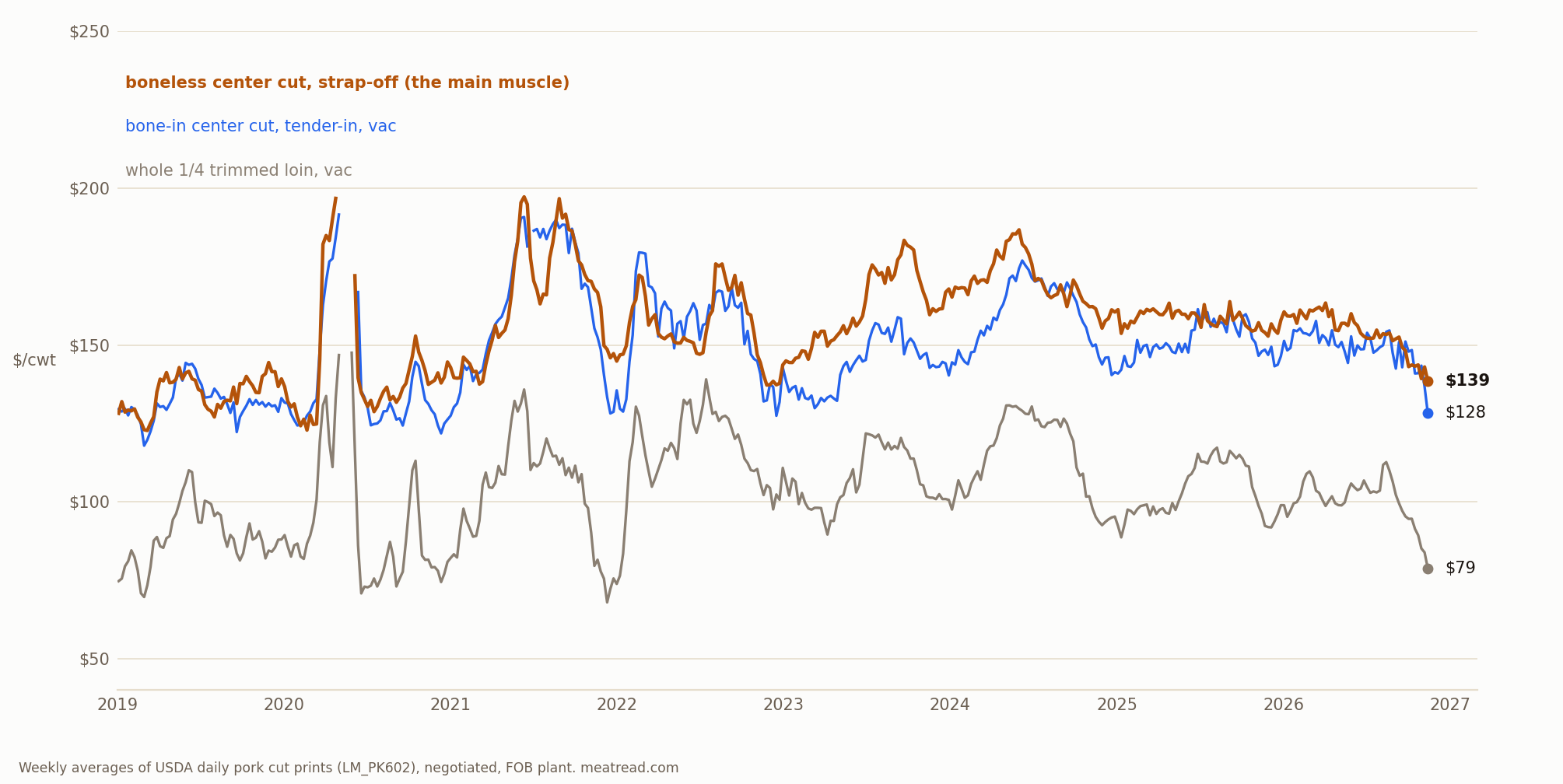
The bone-in pork loin center cut is not the cheap version of the boneless one. It prices within a few percent of it, and some weeks above it. The cheap line is the whole loin, bone in, which trades at about two thirds of the boneless price and is where most of the volume goes. A buyer who reads "bone-in" as "discount" is thinking of the whole loin and quoting the center cut.
The four lines USDA prints
The daily pork report carries the loin at every stage of cutting, and they trade in very different volumes.
| Line, fresh, vac | What it is | Loads a day, 2026 |
|---|---|---|
| 1/4 trimmed loin | The whole bone-in loin, fat trimmed to a quarter inch | 13.0 |
| Boneless center cut, strap-on | The main muscle with the false lean strap left on (the short cut) | 10.3 |
| Boneless center cut, strap-off | The main muscle alone | 7.4 |
| Bone-in center cut, tender-in | The center section of the bone-in loin, tenderloin left in | 2.1 |
The two boneless lines are the same muscle with and without a strap, and the strap-on versus strap-off article is about that choice. This page is about the bone.
Bone-in center cut against boneless: the same price
| Bone-in center cut as a share of boneless strap-off, per lb | |
|---|---|
| Median, daily prints since Jan 2024 | 95% |
| Nine days in ten fall between | 88% and 103% |
| November 11, 2026 | 100% |
The bone-in center cut is a loin cut into chops with the bone left in, and the plant has already done the work that costs money: pulling the shoulder and sirloin ends, trimming, portioning the center. What is left in is bone, and the market does not discount it much. Through the back half of both 2025 and 2026 the bone-in center cut averaged 98 to 101 percent of the boneless. In the first months of each year it ran 92 to 96 percent.
That ratio answers the boning question with no yield table. Boning a bone-in center cut yourself pays only if you get more boneless meat out of a hundred pounds than the price ratio says, before the labor. At 95 percent it never pays. At 100 percent, which is where it printed this week, it cannot. So the bone-in center cut is bought by people who want the bone: chops on the bone for the case or the menu. It is not a route to boneless loin and the market has never priced it as one.
The whole loin is where the spread lives
The line that carries the volume is the whole 1/4 trimmed loin, and it prices at about 65 percent of the boneless strap-off per pound on the median day since 2024. Over the years the boneless has run 1.35 to 1.68 times the whole loin at the yearly median, 1.53 this year.
That gap is the plant's cutting margin. Out of the whole loin come the two center cuts, the sirloin end, the tenderloin, the back ribs and the trim. The ribs article covers the back ribs, which USDA's cutout math frees at about 11 percent of the loin's weight when the loin is boned. The gap also has a season. Measured against each year's own median, the boneless runs furthest over the whole loin in December and January and closest to it in June and July, when the whole loin is dearest against the main muscle. The pattern holds across 2015 to 2025. The data does not say why, so this page does not either.
The fall of 2026
The hook for reading all of this now is that the loin complex is at multi-year lows, and the three lines fell by different amounts.
| Line | 2026 high | Nov 11, 2026 | Change | Last this low |
|---|---|---|---|---|
| Boneless strap-off | $1.77/lb, Mar 20 | $1.33 | -25% | Nov 2022 |
| Bone-in center cut | $1.79/lb, Feb 6 | $1.34 | -25% | Sep 2026, no multi-year low |
| Whole 1/4 trimmed loin | $1.14/lb, Aug 7 | $0.77 | -33% | Jan 2022 |
Against last November the whole complex is lower: the boneless strap-off averaged $1.41 this November against $1.55 a year earlier, the whole loin $0.82 against $0.95, and the pork cutout itself $70 against $96. The loin primal in the cutout averaged $73 against $86. The boneless strap-on, the short cut, is at its lowest since December 2021.
Two things follow for a buyer. The whole loin fell furthest, so the spread between whole loin and boneless is as wide as it gets, which is the plant keeping its cutting margin while the raw material gives. And the bone-in center cut fell exactly as far as the boneless, which is the same market with a bone in it, as it always was.