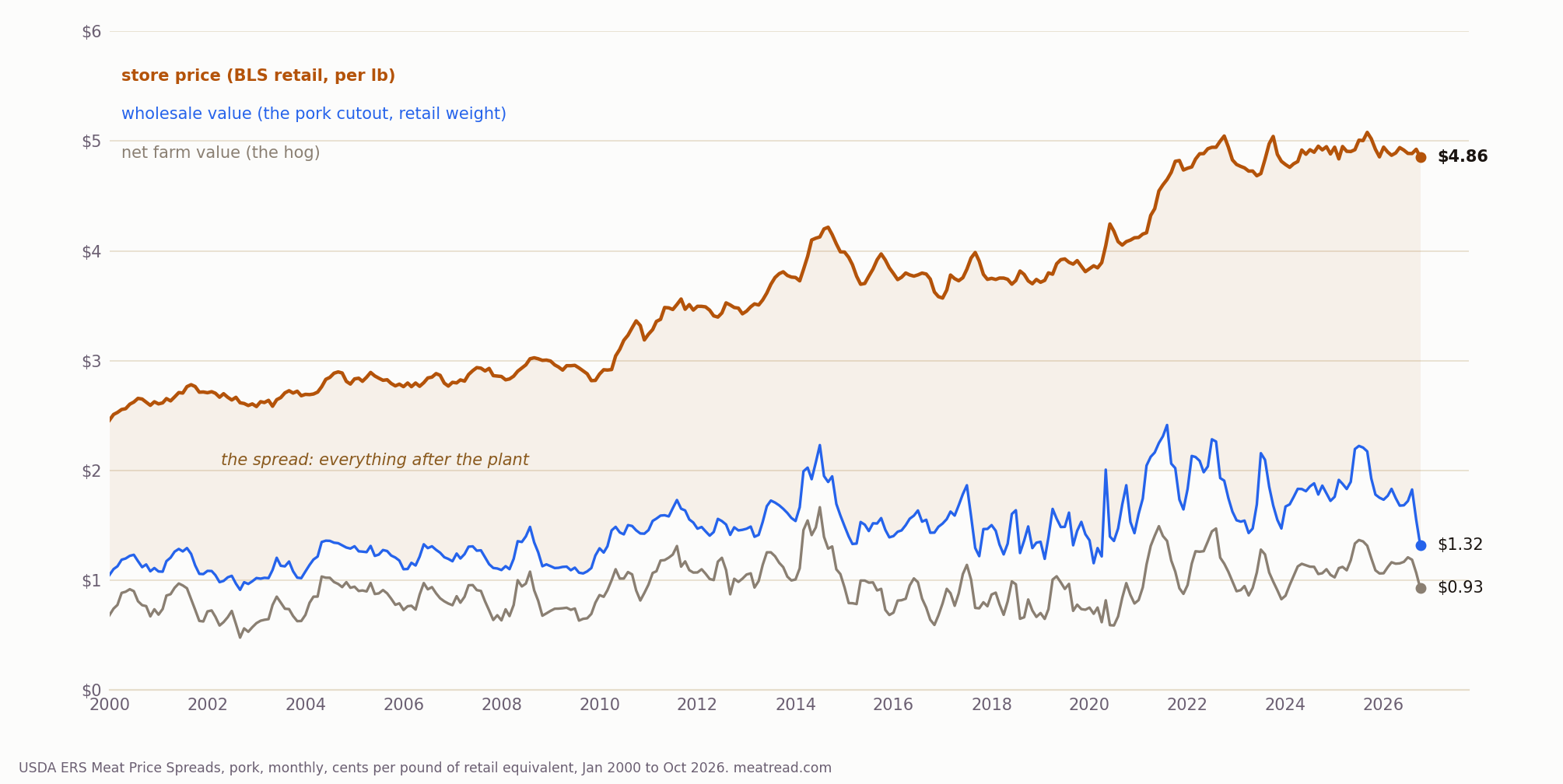
The pork cutout fell 28 percent between August and October 2026. The store price fell less than one percent. The gap between what the plant gets and what the shopper pays is now the widest USDA has recorded in 56 years of keeping the series. That is not unusual in kind, only in size. The shelf follows the cutout up within a few months and follows it down barely at all.
The three numbers ERS publishes
USDA's Economic Research Service prices pork at three stages every month, all per pound of what reaches the shelf, so the three numbers compare directly.
| Per retail pound, October 2026 | |
|---|---|
| Store price (BLS retail survey) | $4.86 |
| Wholesale value (the cutout, converted to retail weight) | $1.32 |
| Net farm value (the hog, less byproduct credit) | $0.93 |
| Wholesale to retail spread | $3.54 |
The spread is everything the pork earns after it leaves the plant: further processing, distribution, and the store. ERS does not split those layers. An importer who sells pork into retail and foodservice says his own prices follow the packers' within days because the market between them is competitive, which leaves the store as the layer where a drop stops.
The farmer's share of the retail dollar was 19 cents in October. It averaged 50 cents in 1980, 31 in 2000, and 23 so far this year.
How long the shelf lags
Month to month, the store price does not move with the cutout in the same month at all. It follows one and two months later, and loosely: the correlation of the monthly changes is zero in the same month and about 0.4 at one and two months. The shelf price is a survey of posted prices, and posted prices change on a schedule the cutout does not keep.
Over a full year, about 42 cents of every dollar the wholesale value moves shows up at the shelf. The direction decides whether that happens.
Rises pass through. Drops stall
Since 2000 the wholesale value has jumped 20 cents or more within three months thirteen times, and fallen that much twelve times. What the shelf did afterward:
| Three-month wholesale move of 20 cents or more | Rises, 13 cases | Drops, 12 cases |
|---|---|---|
| Median wholesale move | +28 cents | -29 cents |
| Median shelf change, three months on | +19 cents | -4 cents |
| Median shelf change, nine months on | +14 cents | 0 |
| Shelf still higher, or lower, nine months on | 12 of 13 | 6 of 12 |
Every rise reached the shelf within a quarter. Half the drops never reached it at all, and the median drop was fully absorbed by month nine. The same asymmetry holds in the everyday data: across every six-month window since 2000, when the wholesale value rose more than a nickel the shelf rose a median 11 cents, and when it fell more than a nickel the shelf fell a median 3 cents.
October 2026
The wholesale value went from $1.83 in August to $1.32 in October, its lowest since April 2020. The shelf went from $4.89 to $4.86. The spread, $3.54, beat the prior record set the month before, and before that the record was October 2023 at $3.36. As a share of the shelf price the spread is 73 percent against a prior high of 70 percent in February 2020.
The retail price itself is not rising. It peaked at $5.08 in September 2025 and has averaged $4.90 this year against $4.95 last year. The record spread is the cutout falling under a shelf that is holding, not the shelf going up.
One caveat on the series: ERS notes that October 2025 retail data from the Bureau of Labor Statistics was missing because of the lapse in appropriations, and USDA's own retail data was used for that month.