Bull meat is the lean trim from young uncastrated cattle, and nearly all of what the US imports comes from New Zealand. USDA prices it every week as "Bull Meat (95%)" on the Import Beef Trade report, and the trim price tells you what the grind market pays for: the lean points and the origin, not the bull. Over five years of weekly prints, imported bull 95 sold for the same money as imported cow 95, about 20 cents a pound over cow 90, and about 34 cents under the domestic fresh 90s. This page is the bull lines, what is behind them, and the domestic bull line that USDA stopped printing in 2013.
What bull beef is
In New Zealand, bull beef comes from dairy-origin male calves that are left entire and grown out on grass for the manufacturing trade. The animal is lean, and the meat is lean, dark and firm, with a high water-binding capacity. That last property is why processors want it: it holds moisture and fat in a sausage or a formed product, so a grinder or a sausage maker pays for bull meat as a binder as well as a lean source. Australia ships some bull meat too, and USDA prints Australia and New Zealand on one line. South America's bull line has printed since 2024.
Because the carcass is lean, bull trim tests high. It ships as 95s, the same lean grade as cow 95, and the two sit side by side on the report.
Where it prints, and the line that died
USDA's Import Beef Trade report, NW_LS421, prices imported boneless beef weekly: bull 95, cow 95, cow 90 and the 85s for Australia and New Zealand, and bull 95 and cow 90 for South America, for delivery within 15 days and for 16 to 45 days out. The imported lean article covers the report and how imports sit against the domestic grind. This page stays on the bull lines.
There was a domestic bull line once. USDA's daily boxed beef report carried "bull product, fresh 94-96%" from 2004 to 2013. It printed steadily only from 2009 to 2012, thinned out in 2013, and the last regular print was November 6, 2013. The US does not finish bulls for the manufacturing trade the way New Zealand does, so the domestic line was always thin. Today the only USDA bull price is the imported one.
What the price rewards
The yearly medians, spot, cents per pound:
| Year | AU/NZ bull 95 | AU/NZ cow 95 | AU/NZ cow 90 | South American bull 95 | Domestic 90s |
|---|---|---|---|---|---|
| 2024 | 305 | 304 | 291 | 301 | 348 |
| 2025 | 358 | 356 | 340 | 337 | 389 |
| 2026 to Oct 30 | 403 | 398 | 377 | 343 | 450 |
Bull 95 and cow 95 are the same price. Over five years bull printed above cow 95 on 96 percent of weeks, but the median gap was 2 cents, and the two were within 5 cents of each other on 93 percent of weeks. A buyer who wants the binding quality gets it for a cent or two. The market does not pay a premium for the bull.
Bull 95 over cow 90 is the lean premium. The gap ran 20 cents at the five-year median and 26 cents in the last 12 months. Cow 95 over cow 90 ran 18 cents over the same five years. So that 20 cents is five points of chemical lean, not the animal.
Origin is the other thing the price pays for. Australian and New Zealand bull 95 printed above South American bull 95 on every week since the South American line began: 18 cents at the median over the run, and 46 cents in the last 12 months. The South American discount has widened as the two markets pulled apart in 2026.
Against the domestic 90s
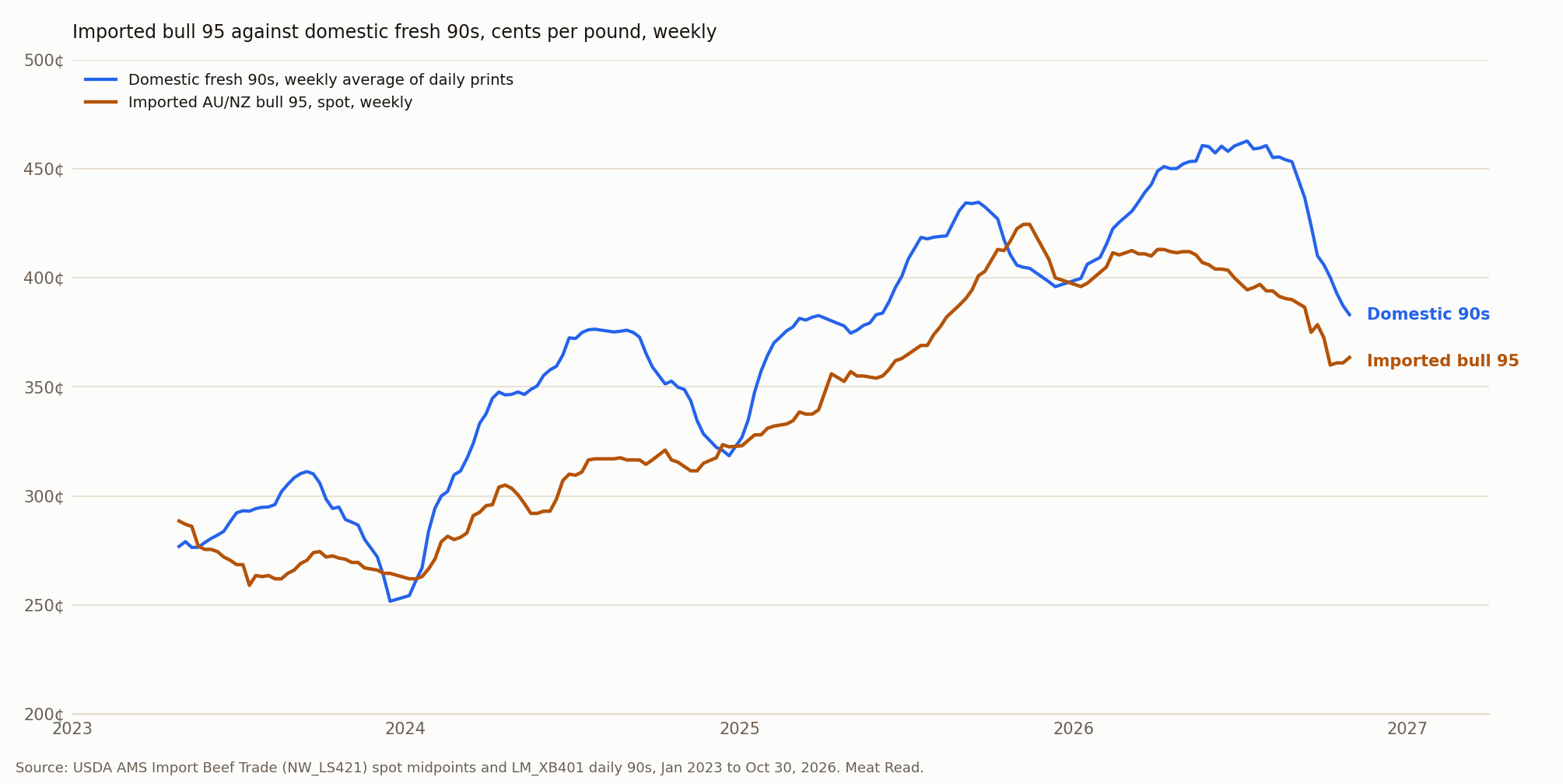
Imported bull 95 is five points leaner than the domestic fresh 90s and sells for less. Over five years it ran 34 cents under the weekly average of the domestic daily prints, 38 cents under in the last 12 months, and it printed above the domestic 90s in only one week in ten. The chart shows the two lines: domestic 90s ran away through 2025 and the first half of 2026, and bull followed at a distance.
That is a recent shape, not a law. In 2018, the earlier stretch of the file, bull 95 and domestic 90s printed within a few cents of each other, and in the spring of 2023 bull sat above. The discount is the import market's discount: delivery weeks out, quota, exchange rates and the other buyers for Oceania lean. The imported lean article covers those.
The primals
The same bulls yield primals, and those come into North America too, knuckles and eye rounds among them, for roast beef, fondue and other sliced programs. Buyers who bring them in want them for the leanness and for a bigger piece of meat than a cow of the same grade gives, and that is where the bull is paid for. In late 2026 bull knuckles and eye rounds are selling over the cow cuts, while the trim sells level with cow 95. USDA does not price imported bull cuts, so there is no print to hold a primal quote against.
New Zealand's processors do price the animal on its own grade. The M2 bull schedule is quoted beside the P2 steer, in cents per kilogram of carcass, and it is the farmgate side of this market. It tells you what the exporter paid for the bull, not what a knuckle or a load of 95s is worth landed.