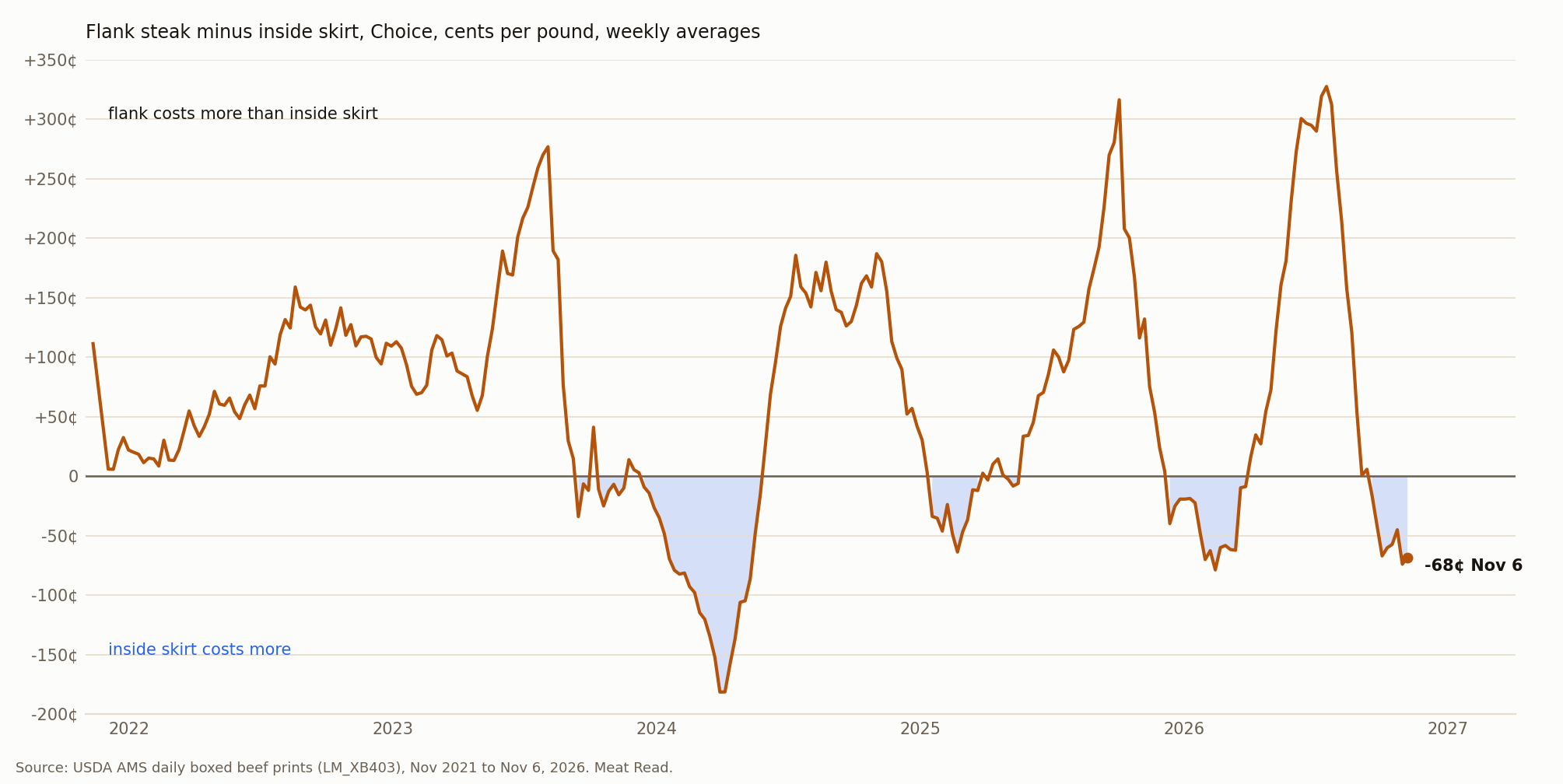
Flank steak is the third fajita cut, and on USDA's daily prints it sits between the two skirts: about 10 percent over the inside skirt and about 16 percent under the outside skirt at the five-year median. It is not a skirt. It is a different muscle from a different primal, and it has its own season, which is why it is sometimes the cheapest of the three and sometimes the dearest. This page is where the flank sits against the skirts, when it moves, and the rule for buying it. The skirt article covers the two skirts against each other.
What the cut is
IMPS 193, Beef Flank, Flank Steak, is the rectus abdominis, the flat muscle of the lower belly, taken out through its natural seams and trimmed practically free of fat and membrane. One per side, so two per animal, like each skirt. It is a lean, coarse-grained, flat steak that marinates well and slices across the grain, which is why it shares the fajita, carne asada and stir-fry slot with the skirts.
The inside skirt (IMPS 121D) is the transversus abdominis from the inner belly wall. The outside skirt (121C) is the diaphragm. All three are thin and coarse, and all three do the same job at the grill.
Where the flank sits
Five years of Choice prints, medians:
| Cut | $/lb | Pounds a day, last 12 months |
|---|---|---|
| Inside skirt | $6.14 | 43,000 |
| Flank steak | $6.51 | 34,000 |
| Outside skirt | $7.92 | 20,000 |
The flank printed above the inside skirt on 72 percent of days and above the outside skirt on 20 percent. The outside skirt is the scarce one and carries the premium. The inside skirt is the volume cut. The flank trades in between, closer to the inside.
That order is not fixed. In 2022 the outside skirt and the flank printed within 12 cents of each other at the yearly median. In 2026 the outside skirt ran to $10.71 at the median against the flank's $7.91, the widest gap in the file. When the outside skirt runs away, the flank is the cut that does the outside skirt's job for less.
Three seasons, not one
The skirts have one season each: May. The outside skirt's monthly median runs 23 percent over its year in May and the inside's 14 percent, then both fade. The flank has a longer and deeper season. It runs 12 percent over its year in June, stays 7 to 9 percent over through August, and falls to 12 percent under in December and 9 percent under in January.
So the flank is the dearest of the three in the grilling months, when it does not need to be bought, and the cheapest from October to March, when the skirts barely move. A buyer who files the flank with the skirts expects a May spike. The flank's spike is June to August, and its trough is the winter.
When the flank is the cheapest fajita cut
On 28 percent of days in five years the flank printed under the inside skirt. Three quarters of those days fell in the fourth and first quarters. The deepest stretch below ran through the winter of 2024, when the flank sat about $1.80 under the inside skirt in late March. The other direction is wider: in July 2026 the flank ran $3.27 over the inside skirt on weekly averages.
The flank has been under the inside skirt since September 15, 2026. On November 6 it printed $5.76 against the inside skirt at $6.21 and the outside skirt at $8.53, down 9 percent in four weeks against the inside skirt's 7 percent.