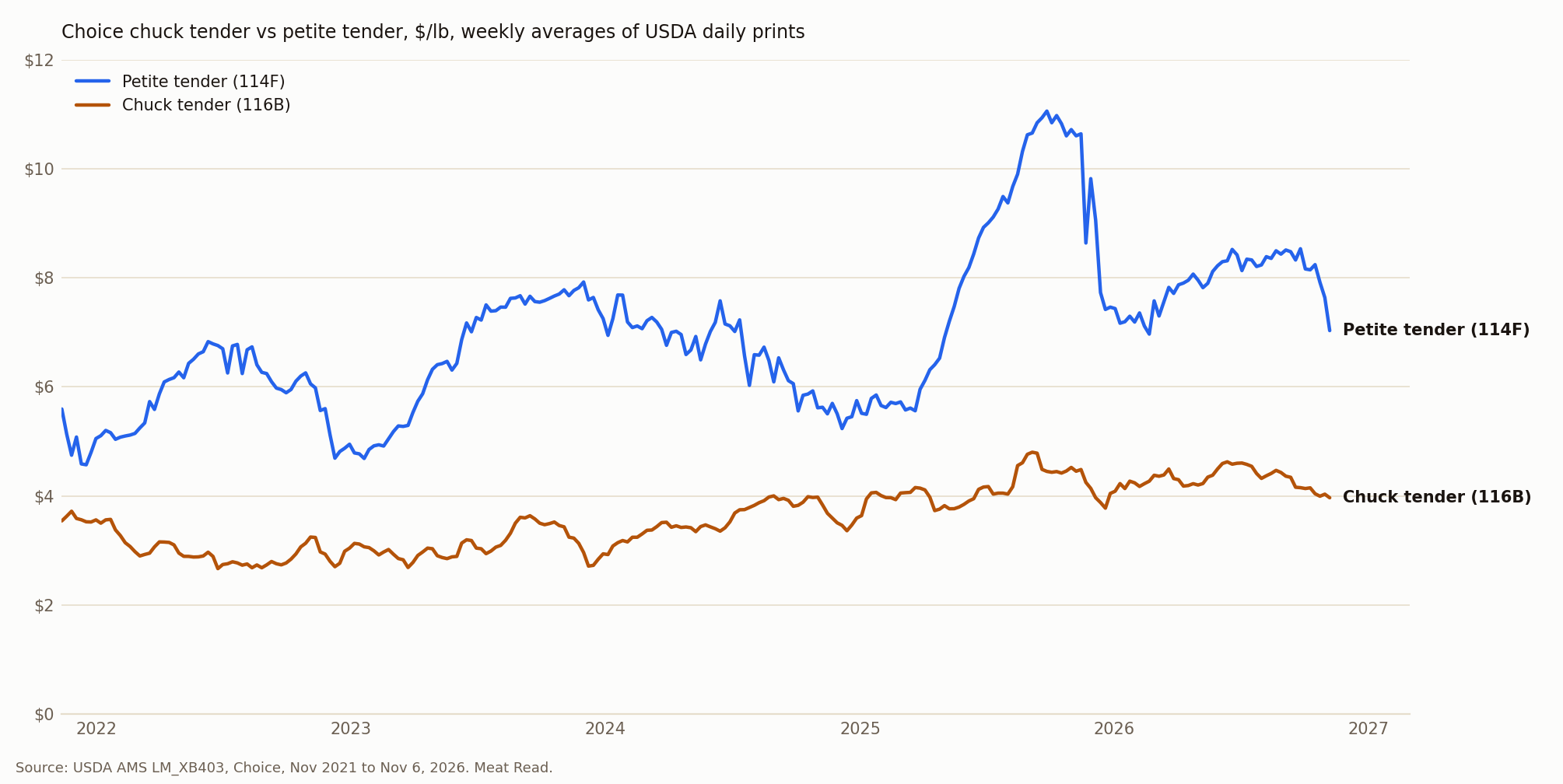
Two muscles off the beef shoulder are sold with the word tender in their name, and one has cost about twice the other for years. The chuck tender is the supraspinatus, the long muscle that sits above the ridge of the blade bone. It is shaped like a tenderloin and it eats tough. The petite tender is the teres major, a small muscle from the inside of the shoulder. It eats like a small filet. USDA prints both every day, under names that do not help: "chuck tender" and "clod tender". This page sets the names straight and shows what the gap between them has been.
The names, side by side
| Chuck tender | Petite tender | |
|---|---|---|
| Muscle | Supraspinatus | Teres major |
| IMPS code | 116B | 114F |
| Other names | Mock tender | Shoulder tender, teres major |
| USDA daily print | Chuck, chuck tender | Chuck, clod tender |
| IMPS weight classes | 3 lb and down, 3 lb and up | 1 lb and down, 1 lb and up |
| Trim option (PSO 1) | Heavy tendon at the thick end butterflied out | Peeled, surface membrane removed |
Teres major and petite tender are the same cut. Teres major is the muscle. Petite tender is the trade name. Shoulder tender is the IMPS name. Clod tender is what USDA's daily report calls it, because it comes off the shoulder clod. Four names, one muscle, one price. The chuck tender is a different muscle with its own code, and the shoulder clod breakdown article covers where the petite tender sits among the other clod parts.
What each one is for
The chuck tender is lean and has a thick band of connective tissue running down its heavy end, which is why the IMPS trim option butterflies that end open to take it out. It sells as a value roast at retail and goes into slicing and braising programs. Its shape is the whole reason for the name: it looks like a tenderloin and that is where the likeness ends.
The petite tender is small, under or over a pound, and tender through. It goes to retail and casual dining, usually cut across into medallions. The trim option peels it and takes the surface membrane off.
What they cost
| Choice, median print | Chuck tender | Petite tender |
|---|---|---|
| Last 12 months | $4.27/lb | $8.07/lb |
| Last 5 years | $3.56/lb | $6.90/lb |
| 2016 | $2.09/lb | $4.33/lb |
Over five years the petite tender printed above the chuck tender on every one of the 1,228 days both traded. The median gap was $3.48 a pound and the ratio was close to two to one. The smallest gap in five years was 52 cents, once; over the last 12 months it never closed to less than $2.15. The two to one ratio is old: it held in 2016 and it holds now.
The petite tender is also the one that moves. Its daily Choice print ranged from $4.05 to $11.30 over five years, and the high came in the autumn of 2025, when it climbed past $11 and then gave most of it back within three months. The chuck tender's range over the same five years was $2.56 to $4.89.
Grade barely matters for one of them
Over five years the Select chuck tender printed within 10 cents of the Choice chuck tender on 69 percent of the days both traded, with a median of 3 cents under. The Select petite tender printed under the Choice petite tender on 90 percent of days, by a median of 54 cents. Marbling is paid for in a muscle that is served as a steak. It is not paid for in a muscle that is sliced thin or braised.
Volume and noise
On a typical day in the last 12 months USDA reported about 59,000 pounds of Choice chuck tender and about 9,800 pounds of Choice petite tender, six times as much of the cheaper cut. Thin lots make a noisy print: over five years the petite tender moved more than 5 percent in a day on 29 percent of days, the chuck tender on 5 percent. Read the petite tender over a week, not off one print.
They do not move together
Over four-week stretches in the last five years the two cuts moved in the same direction only 55 percent of the time, which is close to a coin flip. The chuck tender moves with the chuck. The petite tender has its own buyers and its own price.