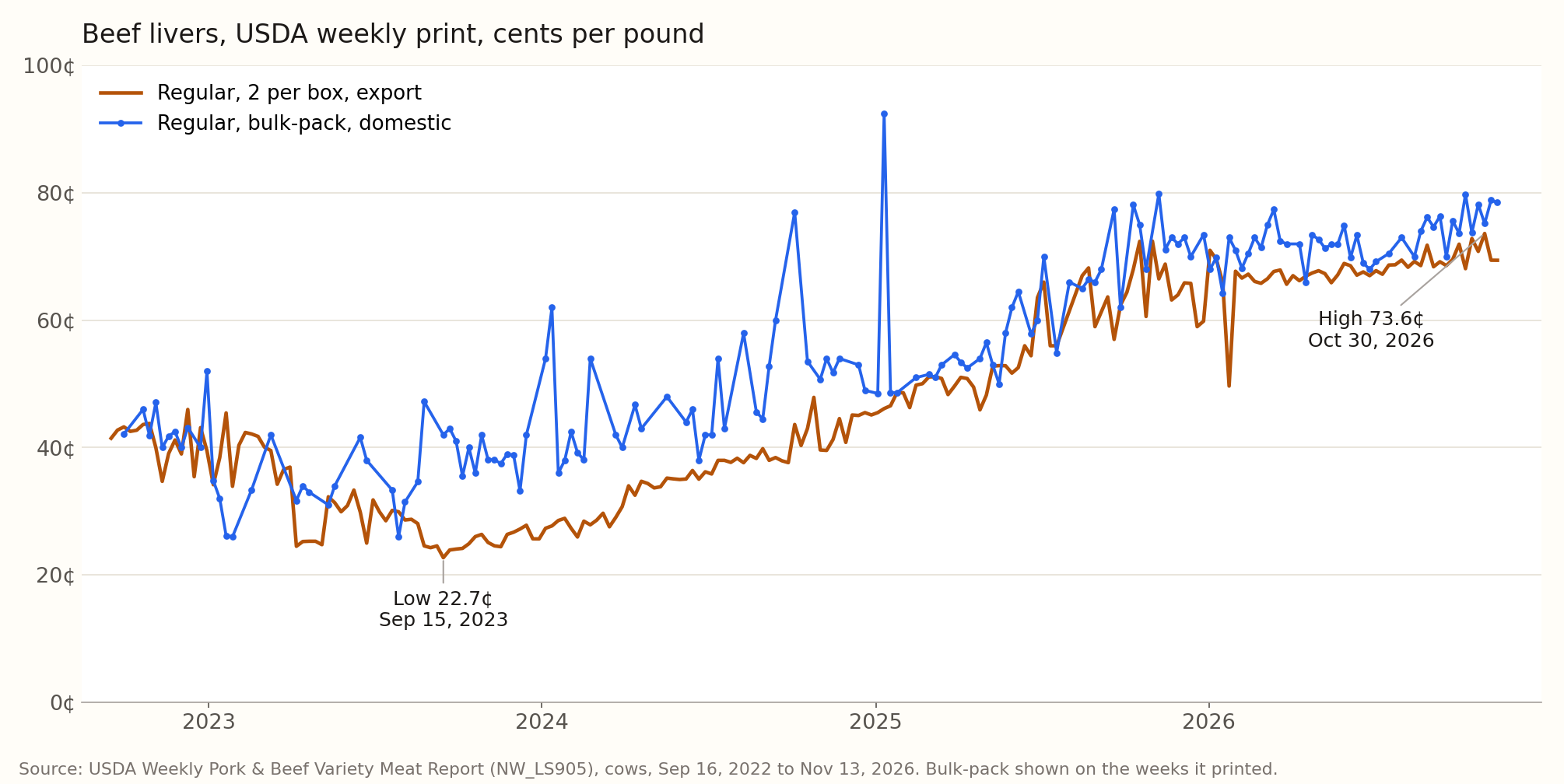
Beef liver is the biggest offal trade USDA reports, and it costs three times what it did three years ago. USDA's export print for cow livers was 22.7 cents a pound on September 15, 2023. On November 13, 2026 it was 69.4 cents, a little under the high of 73.6 cents set two weeks earlier. On a 40,000 pound load that is about $9,000 then and about $28,000 now.
What USDA prints
Liver is not on the daily boxed beef report. It is on the weekly variety meat report, in dollars per hundredweight, which reads the same as cents a pound. Three lines carry nearly all of it, all three for regular livers off cows:
| Line | Prints | Latest |
|---|---|---|
| Regular, 2 per box, export | 214 of 218 weeks | 69.4¢, Nov 13, 2026 |
| Regular, bulk-pack | 157 of 218 weeks | 78.5¢, Nov 13, 2026 |
| Regular, 2 per box, domestic | 85 of 218 weeks | 87.3¢, Oct 30, 2026 |
The export line is the one to watch. It prints almost every week on about nine loads. The bulk-pack line prints most weeks now. The domestic two-per-box line printed twelve times in 2026, usually on a load or less, so one trade can be the whole print. It read $1.09 in September and 87 cents in October on about a load each.
USDA also has lines for selected livers and for livers off steers and heifers. Together they have printed five times since September 2022.
The biggest line on the report
Since September 2022 USDA has reported about 9,700 loads of beef variety meats on this report. Livers are about 3,260 of them, a third of everything, and twice the next item:
| Item | Loads reported, Sep 2022 to Nov 2026 |
|---|---|
| Livers | 3,258 |
| Tripe | 1,616 |
| Hearts | 989 |
| Kidneys | 744 |
About 65 percent of the liver loads are marked export. Hearts and cheek meat are almost all domestic. Most of the liver leaves the country.
Three years, one direction
| Year | Export, 2 per box | Bulk-pack |
|---|---|---|
| 2023 | 30.0¢ | 36.1¢ |
| 2024 | 36.1¢ | 48.4¢ |
| 2025 | 56.7¢ | 62.8¢ |
| 2026 (to Nov 13) | 67.9¢ | 72.6¢ |
Yearly averages, cents a pound. The Choice cutout rose 26 percent between its 2023 average and its 2026 average. The export liver print rose 126 percent. Liver is still cheap beside the box: 69 cents against a cutout near $3.60 a pound. But a buyer who budgeted liver off the 2023 price is paying more than double.
This record starts in September 2022, when USDA's electronic file for the report begins. The high is the high since then, not a claim about every year before it.
Fewer cows, fewer livers
There is one liver per animal, and the regular lines are cow livers. The cow kill has shrunk every year of this run:
| Year | Cows slaughtered, federally inspected |
|---|---|
| 2022 | 7.1 million |
| 2023 | 6.6 million |
| 2024 | 5.5 million |
| 2025 | 5.0 million |
That is about 30 percent fewer cows in 2025 than in 2022, and 2026 is running a little under 2025 through early November. The loads USDA reported followed the kill down: 905 liver loads in 2023, 774 in 2024, 535 in 2025.
This year the reported loads turned up while the kill did not. Through mid-November USDA counted 696 liver loads against 466 in the same weeks of 2025, and most of the gain was domestic, 305 loads against 141. The price went up anyway.
Domestic prints above export
On the 155 weeks both printed, the bulk-pack line was above the export line 134 times, by a median of 6 cents. In 2026 it was above on 39 of 42 weeks, by about 5 cents. The pack is different and the buyer is different, so the gap is not a pure export discount. It does say the export price is not the ceiling.
What the print does not tell you
Two things a quote needs that the report does not carry.
The first is grade. The trade sells human grade livers and pet food grade livers. USDA's lines are variety meat prints. A pet food quote is a different product, so name the grade before you compare a number to the report.
The second is pack. Liver ships in bulk and it ships vacuum packed, and USDA prints bulk-pack and two-per-box as separate lines for that reason. Compare a quote to the line that matches its pack.
The edible trade goes to retail, to restaurants and to ethnic markets.