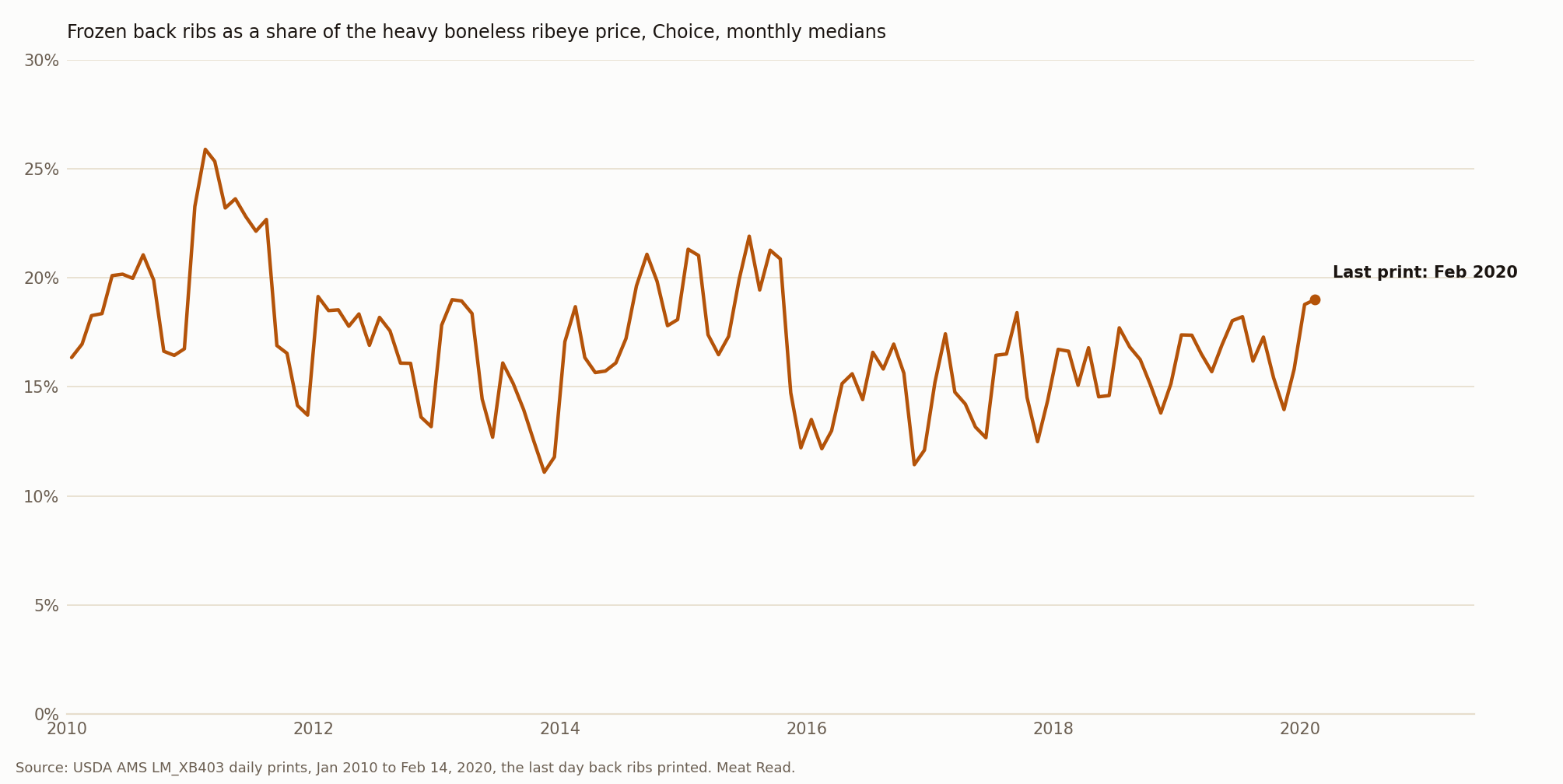
Beef back ribs are the bone section left behind when a rib is boned out into a ribeye roll, and they still trade every day: packers quote them on the daily list. What they do not have is a USDA price. The daily boxed beef report printed fresh back ribs until 2009 and frozen back ribs until February 14, 2020, and has not carried the item since. This page is what the print showed while it existed, and what the retail ad page, which still lists back ribs every week, shows now.
What the cut is
IMPS 124, Beef Rib, Back Ribs, is the intact section of the seven rib bones and the meat between them, taken from the ribeye roll items 109 or 109A. The chine bone and the feather bones are removed, which exposes the sawed ends of the ribs, and the rack runs between 6 and 8 inches wide unless the buyer specifies otherwise. There is no weight class: the spec says "amount as specified".
Every boneless ribeye roll leaves one of these behind. That is the whole economics of the cut. The packer does not decide how many back ribs to make; the ribeye orders decide it. Back ribs go to barbecue and casual dining rib programs and to retail rib packs.
What the print showed for 19 years
USDA's daily report carried frozen Choice back ribs from June 2001 to February 2020. Over the last ten years of that run the yearly median moved between $0.97 and $1.45 a pound. Against the heavy boneless ribeye it was steady in a way the dollar price was not:
| Year | Frozen back ribs, median | Share of the heavy ribeye price |
|---|---|---|
| 2015 | $1.45/lb | 19% |
| 2016 | $1.11/lb | 15% |
| 2017 | $1.12/lb | 15% |
| 2018 | $1.24/lb | 16% |
| 2019 | $1.35/lb | 17% |
From 2010 to the last print the monthly share ran between 11 and 26 percent and its median was 17 percent. The season was the grilling season: January and December printed about 10 percent under the year's median, November about 8 percent under, and May through August 3 to 5 percent over, with June the top.
The line thinned before it stopped. Back ribs printed on 192 of the ribeye's 254 trading days in 2017, 189 in 2018 and 139 in 2019, and the 2019 median day was about 19,500 pounds against 37,000 for the heavy ribeye. The last print, on February 14, 2020, was $1.44 a pound on 13,066 pounds. We have not found a published reason for the item leaving the report. USDA's confidentiality guideline withholds any item when too few packers make up its trade, and a line printing on about half the days is the kind of line that rule catches, but that is a reading, not a record.
What the ad page shows now
USDA's weekly retail feature report still lists beef back ribs, so the cut has a public price at the other end of the chain. In the last 12 months back ribs appeared in 49 of the weekly reports, in a median of 93 conventional stores a week and never more than 576. The median ad price was $4.99 a pound, and it was $4.99 in 2024 and 2025 as well. The report renamed the item from "Beef Backribs" to "Backribs, Regular" in September 2024; before the change the median ad was $2.60 in 2018, $4.03 in 2021 and $4.06 in 2023.
For scale, boneless ribeye steak ads in 2026 ran a median of $17.47 a pound in a median of 1,208 stores. Back ribs are a tenth of the stores and under a third of the price. Their ad season matches the old wholesale season: a median of 150 to 180 stores a week from May through August, and 40 in November and December.
What to benchmark against
A quote with no print behind it needs a reference. For ten years the back rib sat between 15 and 22 cents on the heavy ribeye dollar, with 17 the middle. The ribeye still prints every day, so the ratio is a number you can check a quote against the day it arrives. It is a reference from a run that ended in 2020, not a print.