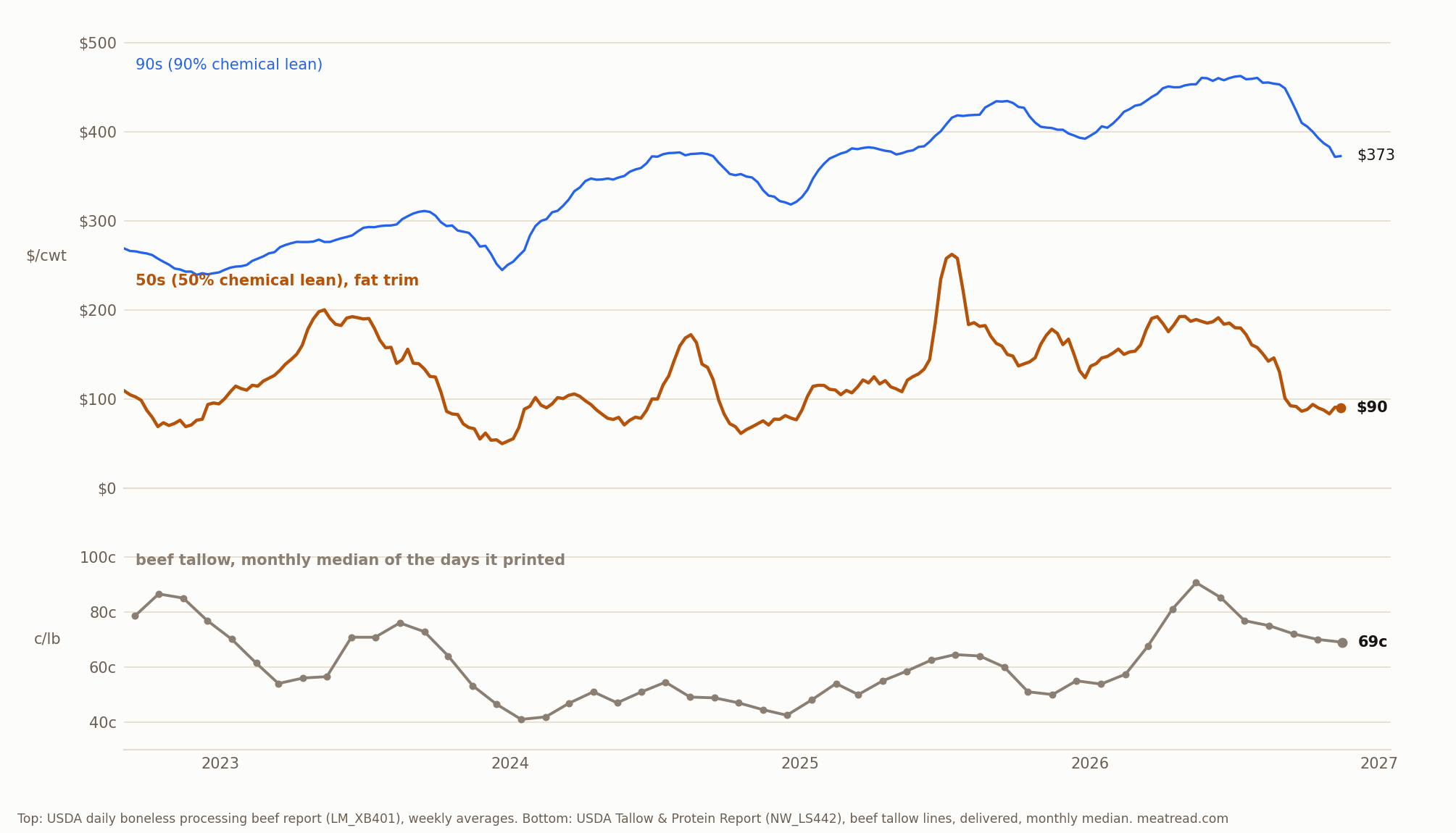
The 50s are the fat trim off fed cattle, half lean and half fat by test, and the cheapest line on USDA's trim report. Two buyers set the price: the grinder and the renderer. The latest print, November 10, 2026, was $94.87 per cwt. In June it averaged $186. The 90s, the lean end of the same report, eased a tenth over the same months. The fat end lost half.
What a 50 is
A 50 is beef trim that tests 50 percent chemical lean, so 50 percent fat. It comes off fed steers and heifers, from most primals, as the fabrication floor trims subprimals to spec. USDA prints it every day on its boneless processing beef report (LM_XB401), beside the 65s, 85s and 90s. The boxed beef report carries a fresh 50 percent line too, as a credit item in the cutout.
It is the most regular line on the report. In 2026 it printed on 203 of 220 report days, and on those days it cleared about 14 loads, up from about 9 loads a day in 2024. The lean trim ladder article covers how the rungs relate. This page is about the bottom rung on its own.
Who buys it
The grinder is the first buyer. Ground beef is sold by its lean percentage, and the cheapest way to hit 80/20 is to blend lean trim with fat trim. Three parts 90s to one part 50s makes 80. The 50s are the fat in the blend, and they are the part that makes the 90s affordable.
Fat trim has other homes. Sausage and hot dog makers buy it, charcuterie makers buy it, and pet food makers buy it, including the ones that feed zoos. Those buyers want the fat as fat, not as a blending tool.
The renderer is the buyer of last resort. Half of every box is fat by definition, and rendered fat is tallow, which has its own market and its own USDA report. When nobody in the grind wants the 50s, the renderer still does, at tallow value. That is the floor under the price. It is not the price.
The fat end has a season
The 50s have a clear season. From 2010 to 2025, the median print in March and April ran about 12 percent above its year's median. In October it ran about 19 percent below. September and October are the cheap months almost every year.
So a fall drop is normal. The size of this year's drop is not.
2025 to 2026: the run and the fall
| Period | 50s, $/cwt, average of daily prints |
|---|---|
| Mar to May 2025 | $118 |
| Jul 2025 | $236 (high $268.14 on Jul 10) |
| Mar to Jun 2026 | $185 |
| Sep 1 to Nov 10, 2026 | $90 |
The yearly medians tell the longer story: $131 in 2023, $90 in 2024, $137 in 2025, $158 in 2026 so far. Outside the spring of 2020, when plants closed and the line printed $24.56 on April 3 and $292.69 on May 13, the 2025 and 2026 levels are the highest in the series.
The fall from June was steeper than the rest of the report. Between the spring months and September to November the 90s averaged 10 percent less, the 65s 32 percent less, and the 50s 51 percent less. The 50s went from two fifths of the 90s price in the spring to a fifth now.
Tallow: the floor, not the price
Beef tallow printed about 47 cents a pound in 2024, 55 in 2025 and 75 so far in 2026, with a monthly high of 91 cents in May. It has come off since, to about 69 cents in November. So tallow and the 50s both peaked in the second quarter of 2026 and both came down. Tallow lost about a quarter of its value. The 50s lost half.
The two series do not track. In the spring of 2023 the 50s ran near $200 while tallow sat in the mid 50s. In the fall of 2026 the 50s sit at $90 with tallow near 70. Tallow tells you where the renderer's bid is. The grinder's bid, and what the sausage and pet food buyers are paying, sits above it by an amount that tallow cannot predict.